

Collapsing Construction Sites Pose a Major Challenge to the Vision of a Developed India
By Manohar Manoj

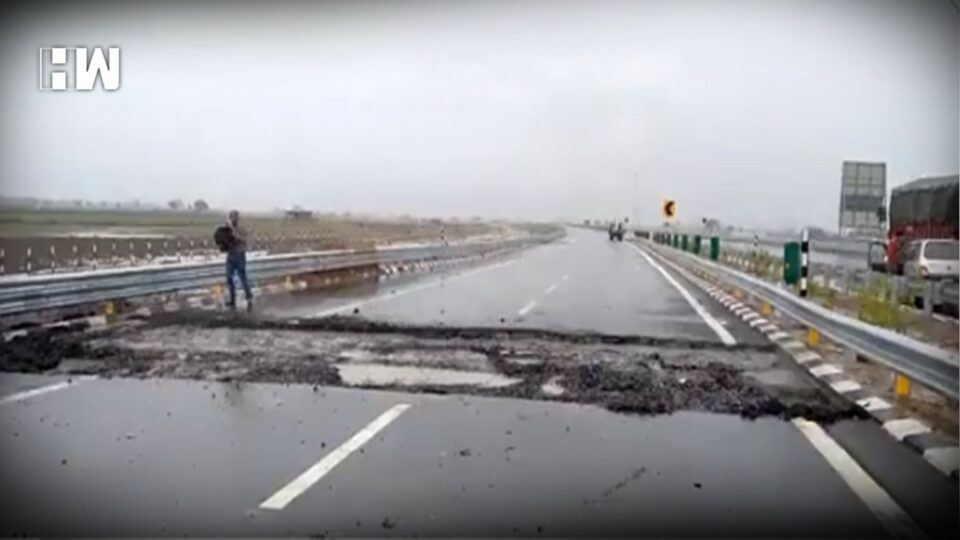
The news of damage, collapse and structural failure at numerous public construction sites across the country continues unabated. Ironically, many of these projects were inaugurated by the Prime Minister. A few days ago, a ten-metre-deep cavity developed near Unnao on the 594-kilometre-long, six-lane Ganga Expressway—built at a cost of ₹36,000 crore—between Meerut and Prayagraj, following heavy monsoon rains and soil erosion. Earlier, a 20-metre-long crack had damaged the road near Amroha on the same expressway. At Hapur, also on this route, an SUV overturned several times because of a defect in the road, resulting in the deaths of four people. The Prime Minister inaugurated this road project on 29 April.
 A similar incident occurred on the Delhi–Dehradun Expressway, which was inaugurated by the Prime Minister with great fanfare on 14 April. The project, costing approximately 1.25 billion dollars, developed two large potholes in Shamli on 1 July, within three months of its inauguration. The National Highways Authority of India (NHAI), the central agency responsible for the construction of highways in the country, explained that the incident occurred because the slope and drainage channel required for the disposal of rainwater could not be completed due to a land-acquisition dispute. However, the NHAI issued show-cause notices to the project director, the authority’s engineer and the construction contractor, and suspended several of its employees. The road was restored after an emergency drainage system was constructed.
The third example comes from Bihar, where there have been several incidents involving the collapse of public infrastructure, particularly bridges. Only a few days ago, on 10 September, a large concrete segment of an under-construction four-lane bridge near Lalganj in Vaishali district collapsed along with an iron girder launcher, seriously injuring eight workers. This bridge was part of the central government’s Bharatmala project. Earlier, on 4 May, a massive slab of the important Vikramshila Bridge over the Ganga in Bhagalpur fell into the river. This occurred despite the fact that the bridge’s chief engineer had declared it completely safe just a week earlier. Following the incident, connectivity between Bhagalpur and north Bihar, Bengal and Jharkhand remained disrupted for several days.
A third incident occurred in Gopalganj district last March, when a small bridge constructed over the Ghoghari River collapsed. It is another matter that three engineers associated with the construction were suspended and the contractor was blacklisted.
It is deeply ironic that, while India is strongly demonstrating its resolve to become a developed country, construction projects across the nation are repeatedly breaking apart, collapsing and causing accidents. During the past two years, nearly two dozen major infrastructure projects—including national highways, expressways, airports, flyovers, bridges, statues and various public buildings—have reportedly suffered damage, structural failure or collapse.
A shocking incident came to light in Bihar, where a three-kilometre bridge being constructed between Khagaria and Bhagalpur at a cost of ₹1,700 crore collapsed three times. When the Indian Institute of Information Technology, Roorkee, investigated the project, it found that the quality of the construction materials was substandard. This indicates that corruption was repeatedly allowed to continue.
Union Minister for Road Transport and Highways Nitin Gadkari, often described as India’s highway-maker, has also appeared helpless on several occasions in the face of declining construction standards and highway-related accidents. The Delhi–Mumbai Expressway, one of the country’s most important expressway projects, has witnessed several incidents involving weak or defective construction. First, potholes developed in Dausa and Sawai Madhopur in Rajasthan. Later, an eight-foot-deep pothole appeared at Ankleshwar in Gujarat.
The Sanchore–Santalpur highway in Gujarat also developed cracks and rough patches following rainfall. In this case, the road contractor was fined ₹2.8 crore and barred from undertaking work for one year. In view of defects found in around 19 new highway projects, Minister Nitin Gadkari has so far dismissed 11 NHAI officials.
These incidents raise several questions. First, they undermine India’s vision of becoming a developed nation. At the same time, they damage the reputation of the quality of our public construction both within the country and abroad. These incidents are living proof of how deeply corruption has penetrated the public system. They also expose the weaknesses of the administrative machinery that claims to follow a policy of zero tolerance towards corruption.
From an economic perspective, these incidents represent a blatant violation of the principle of value for public money. The worrying aspect is that the negligence and greed of a few individuals result in accidents and give rise to what may amount to criminal acts. For example, in a hydropower project under construction in northeastern India, the collapse of a tunnel resulted in the deaths of nine workers and left 15 others seriously injured.
Even in Kerala, a state known for relatively better governance, eight out of 26 highways under construction suffered damage. In Malappuram, a 250-kilometre-long elevated corridor on National Highway 66 collapsed.
Overall, India is pursuing rapid infrastructure expansion with the aim of accelerating multiplier-led economic growth. However, systemic corruption is preventing this vision from becoming a reality. The question is whether the responsibility for these incidents lies with substandard construction materials and commission-driven practices. At the same time, the incidents point towards an unholy nexus among government officials, politicians and contractors. Unless this nexus is dismantled, the collapse of public construction projects will not stop—and until then, the vision of a developed India will remain merely a slogan.
It is important to note that, apart from corruption, these failures are also caused by construction designs that are not monsoon-proof, technical deficiencies in project implementation, and the haste and pressure applied to meet construction deadlines. The solution lies in exercising the utmost care and sensitivity while undertaking permanent construction works, making them capable of withstanding all weather conditions, and awarding contracts only to highly competent, honest and technically qualified construction companies.
Finally, all such construction sites should be thoroughly tested throughout the entire monsoon season and commissioned only after they have successfully passed these tests.